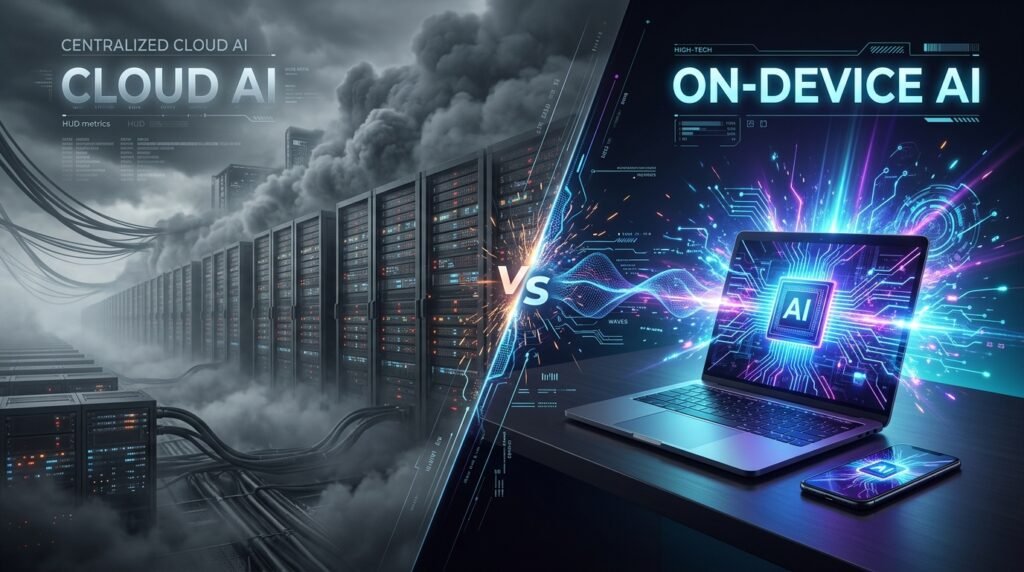
On-Device AI ready to challenge cloud dominance in a changing AI landscape
Artificial intelligence has traditionally depended heavily on cloud computing. Powerful remote data centres have provided the processing capacity needed to train and run increasingly sophisticated AI models. However, the technology landscape is changing quickly. On-Device AI ready to challenge cloud dominance is becoming a major trend as smartphones, PCs, cars, wearables, and other connected devices gain more powerful processors.
The idea behind On-Device AI ready to challenge cloud dominance is straightforward: instead of sending every AI request to a remote server, devices can perform more tasks locally. This approach can make AI services faster, more private, and potentially more reliable when internet connectivity is limited.
For consumers and businesses across the US and UK, On-Device AI ready to challenge cloud dominance could represent one of the most important shifts in everyday computing.
Why On-Device AI ready to challenge cloud dominance matters
The rise of On-Device AI ready to challenge cloud dominance is closely connected to improvements in processors and dedicated AI hardware. Modern smartphones and computers increasingly include neural processing units and other specialised components designed to handle AI workloads efficiently.
This development makes On-Device AI ready to challenge cloud dominance more than a technology concept. It is becoming a practical strategy for manufacturers and software companies looking to deliver AI features directly on user devices.
When AI processing happens locally, users may experience faster responses because information does not always have to travel to a distant data centre and back.
That speed is one reason On-Device AI ready to challenge cloud dominance is attracting attention across the technology industry.
On-Device AI ready to challenge cloud dominance through better privacy
Privacy is another major factor behind the growing interest in On-Device AI ready to challenge cloud dominance.
Cloud-based AI often requires data to be transmitted to remote infrastructure for processing. Depending on the application, that data could include personal conversations, photographs, documents, location information, or business content.
With On-Device AI ready to challenge cloud dominance, more processing can take place directly on the user’s hardware. Keeping certain information on the device can reduce the amount of sensitive data that needs to leave it.
This does not automatically make every on-device AI system completely private, but On-Device AI ready to challenge cloud dominance can give developers more opportunities to design privacy-focused experiences.
For businesses handling confidential information, On-Device AI ready to challenge cloud dominance could become particularly attractive.
On-Device AI ready to challenge cloud dominance with faster responses
Latency is another important advantage. Applications such as voice assistants, real-time translation, image recognition, accessibility tools, and intelligent productivity software can benefit from quick responses.
When processing occurs locally, On-Device AI ready to challenge cloud dominance can reduce dependence on network connections. A device does not necessarily have to wait for information to travel between the user and a remote server.
This could make On-Device AI ready to challenge cloud dominance especially valuable for applications where milliseconds matter.
Imagine a smart vehicle detecting an obstacle or a phone translating a conversation. In these situations, faster local processing can improve the overall user experience.
On-Device AI ready to challenge cloud dominance in smartphones
Smartphones are likely to remain one of the biggest platforms for On-Device AI ready to challenge cloud dominance.
Modern phones already use AI for photography, speech recognition, security, battery optimisation, text prediction, and personalisation. As mobile chips become more capable, more advanced AI workloads can potentially run without constant cloud connectivity.
The growth of On-Device AI ready to challenge cloud dominance could therefore change how consumers interact with their smartphones.
Instead of treating AI as a separate online service, users may increasingly experience AI as a built-in capability of the device.
On-Device AI ready to challenge cloud dominance in PCs
Personal computers are another important area for On-Device AI ready to challenge cloud dominance.
AI-enabled PCs can use local processing for tasks such as document summarisation, image enhancement, meeting assistance, transcription, coding support, and productivity features.
For professionals in the US and UK, On-Device AI ready to challenge cloud dominance could offer a useful combination of speed and privacy. Employees may be able to perform certain AI tasks locally without sending every piece of information to an external service.
At the same time, businesses will need clear policies governing which AI workloads can be processed locally and which require approved cloud platforms.
On-Device AI ready to challenge cloud dominance does not mean the cloud is disappearing
It is important to understand that On-Device AI ready to challenge cloud dominance does not necessarily mean cloud computing will become obsolete.
Cloud infrastructure remains essential for training large AI models, handling complex workloads, storing massive datasets, and delivering services that require significant computing power.
Instead, On-Device AI ready to challenge cloud dominance is likely to create a hybrid model.
Some tasks will happen on the device, while more demanding workloads will continue to rely on cloud infrastructure. This combination can give users the benefits of local processing while preserving access to powerful remote AI systems.
On-Device AI ready to challenge cloud dominance and the role of AI chips
Specialised hardware is central to On-Device AI ready to challenge cloud dominance.
Chipmakers are developing processors that can perform AI calculations with greater energy efficiency. Neural processing units and other AI accelerators are becoming increasingly common in smartphones, laptops, vehicles, and edge devices.
As hardware improves, On-Device AI ready to challenge cloud dominance becomes easier to implement at scale.
Better AI chips could allow developers to run more sophisticated models locally without dramatically reducing battery life or device performance.
On-Device AI ready to challenge cloud dominance and business opportunities
Businesses may also benefit from On-Device AI ready to challenge cloud dominance.
Retailers, healthcare technology companies, manufacturers, financial institutions, and professional services firms could use local AI for specific applications where privacy, speed, or offline functionality is important.
The commercial potential of On-Device AI ready to challenge cloud dominance is therefore broader than smartphones and laptops.
Companies could develop AI-powered products that operate reliably even when connectivity is poor. This may be especially useful in industrial environments, remote locations, transportation, and other situations where constant cloud access is not guaranteed.
On-Device AI ready to challenge cloud dominance: challenges remain
Despite its advantages, On-Device AI ready to challenge cloud dominance faces several challenges.
Device hardware has limited processing power, memory, storage, and battery capacity compared with large cloud data centres. Developers therefore need to optimise AI models carefully.
Security is another concern. Local AI models may be exposed to attempts at reverse engineering, manipulation, or unauthorised access.
There is also the issue of model updates. Maintaining and improving AI capabilities across millions of individual devices can be more complicated than updating a central cloud service.
These challenges mean On-Device AI ready to challenge cloud dominance will not happen overnight.

On-Device AI ready to challenge cloud dominance in the future
The future of On-Device AI ready to challenge cloud dominance will likely involve a balance between local and cloud computing.
Simple, privacy-sensitive, or latency-critical tasks could increasingly run directly on devices. More demanding workloads could continue to be processed in the cloud.
This hybrid approach means On-Device AI ready to challenge cloud dominance may not actually replace cloud AI. Instead, it could redefine the relationship between devices and cloud platforms.
For consumers, the result could be faster and more private AI experiences. For businesses, it could mean greater flexibility in how sensitive information is processed.
Conclusion: On-Device AI ready to challenge cloud dominance
The rise of On-Device AI ready to challenge cloud dominance signals an important evolution in artificial intelligence. Improvements in processors, AI accelerators, and software are making it possible for devices to perform increasingly sophisticated tasks locally.
Privacy and speed are two of the strongest reasons behind On-Device AI ready to challenge cloud dominance. Users want responsive technology, while businesses increasingly care about controlling sensitive information.